
What a Lehi Resident Lookup Covers
A Lehi resident lookup should be framed as one question about one person, not a search for every detail about someone. Property records answer an ownership question. Xchange answers a court-index question. Vital and marriage routes answer a defined family-history question. DOPL and Utah Commerce show a professional or entity connection only when one exists.
| Record | What It Confirms | Where | Access |
|---|---|---|---|
| Assessor / Land Records | Owner, serial, situs, mailing, deed path | Utah County | Online, counter fallback |
| Voter information | Own status or lawful file fields | Vote Utah / County Clerk | Protected data omitted |
| Court index | Case, party, court, dates, public history | Utah Courts Xchange | Paid index and documents |
| Vital and marriage | Historical index or certified-copy route | OVRS / County Clerk / Archives | Release and relationship rules |
| License or entity | Profession, status, principal, entity | DOPL / Utah Commerce | Current registry routes |
Use an address first when you have one, a name first when the person is tied to a parcel or business, and a historical source first when the goal is family reconnection. Current identity and historical identity are different tasks.
Verify a Lehi Resident’s Record Trail
Verification means making the person fit more than one record without collecting more detail than the question needs. A name plus parcel serial is stronger than a name alone. A court party with the same address and date is still a clue, not automatic identity proof. Treat every custodian’s field as separate.
- Anchor the name to a known Lehi address, parcel serial, relative, or date.
- Run the Utah County owner-name route and keep the situs and mailing fields distinct.
- Search Xchange with surname, first-name variants, jurisdiction, county, case type, and dates.
- Use a marriage, death, newspaper, license, or historical index only for the defined question.
- Order a certified copy from the proper custodian only when the release rule allows it.
- Docket
- The court’s ordered history of filings, hearings, judgments, and other case activity.
- Index versus image
- An index helps find a case or record; an image is the underlying document and may have a separate charge or restriction.
- Certified copy
- A custodian-issued copy with a certification, available only under the record’s access rules.
Legal Limits on a Lehi Resident Lookup
GRAMA makes many Utah government records presumptively public, but it does not open every field or force an office to create research. Vital records have release periods and relationship rules. Court systems suppress sealed, expunged, juvenile, adoption, and other protected matters. Voter products can omit at-risk people. Corrections, registry, DMV, and utility records have narrower purposes.
Lawful use. A Lehi resident lookup is for a defined personal, family-history, civic, or safety purpose. Utah’s stalking law covers repeated monitoring, approaching a residence or neighbors, communicating, photographing, or disseminating information used to intimidate. Never use a result to stalk, harass, threaten, or harm anyone.
Search Lehi Resident Records in Xchange
Utah Courts Xchange covers district and justice cases in CORIS. Its fields include jurisdiction, search type, case number, last name or company, first name, case type, search scope, birth date, citation number, citation location, and date panels for filing, disposition, judgment entry, or judgment disposition. Use a wildcard for name variants and narrow the scope when a broad name returns too much.
| Typical result | County, court location, case type, case number, filing date, first and last party, birth date where typically used for criminal defendants, party code, and case-history or document links. |
|---|---|
| Limits | Results cap at 500. Sealed, expunged, juvenile, adoption, child-welfare, and other protected matters may not appear. |
| Document cost | Xchange documents cost $1 each regardless of page count, according to the court material. |
A Utah Courts Xchange or Lehi Justice Court question can also go to the clerk at 154 N Center, 385-201-1090. Ask for the local file when an index row does not answer the question. A case number is evidence of a court record, not proof of current residence, wrongdoing, or guilt.
Utah Courts Xchange help documents the fields shown in this search image.
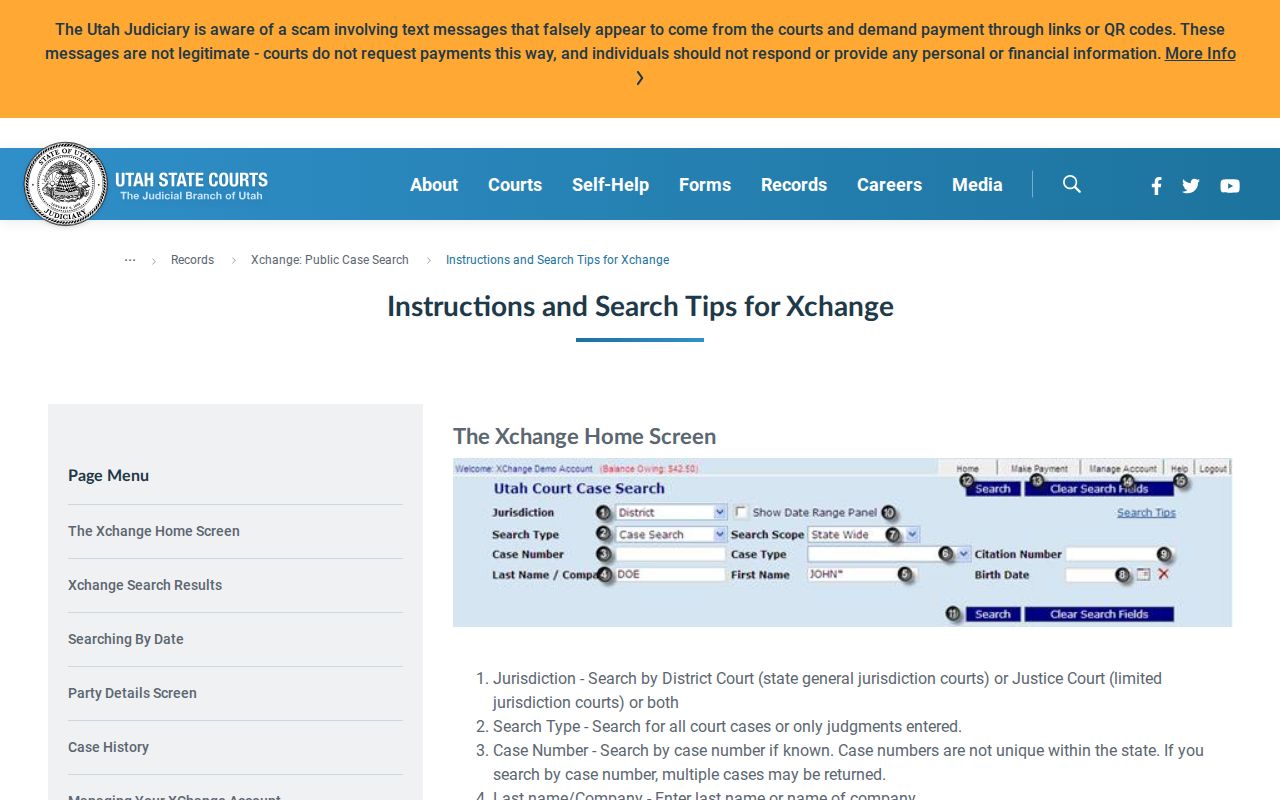
The Xchange image highlights why jurisdiction, name variants, and dates matter in a one-person search.
Order a Lehi Vital Record
Utah birth records become public after 100 years, death records after 50 years, and other vital records after 75 years under Utah Code 26B-8-125. Before those periods, certified access depends on a legally specified relationship or direct, tangible, legitimate interest. The state OVRS route handles current ordering, while Archives holds older Utah County registers.
The County Clerk marriage index can expose an applicant, spouse, and ceremony date. The state request form asks for spouse names, place, date, relationship choice, contact information, number of certificates, signature, and payment. It handles marriage and divorce records for 1978–2010 and limited marriage records from 2011 onward. A no-record search certificate may be issued, but an index hit is not permission to order a certified copy.
Utah death-record access guidance is the source for this eligibility image.
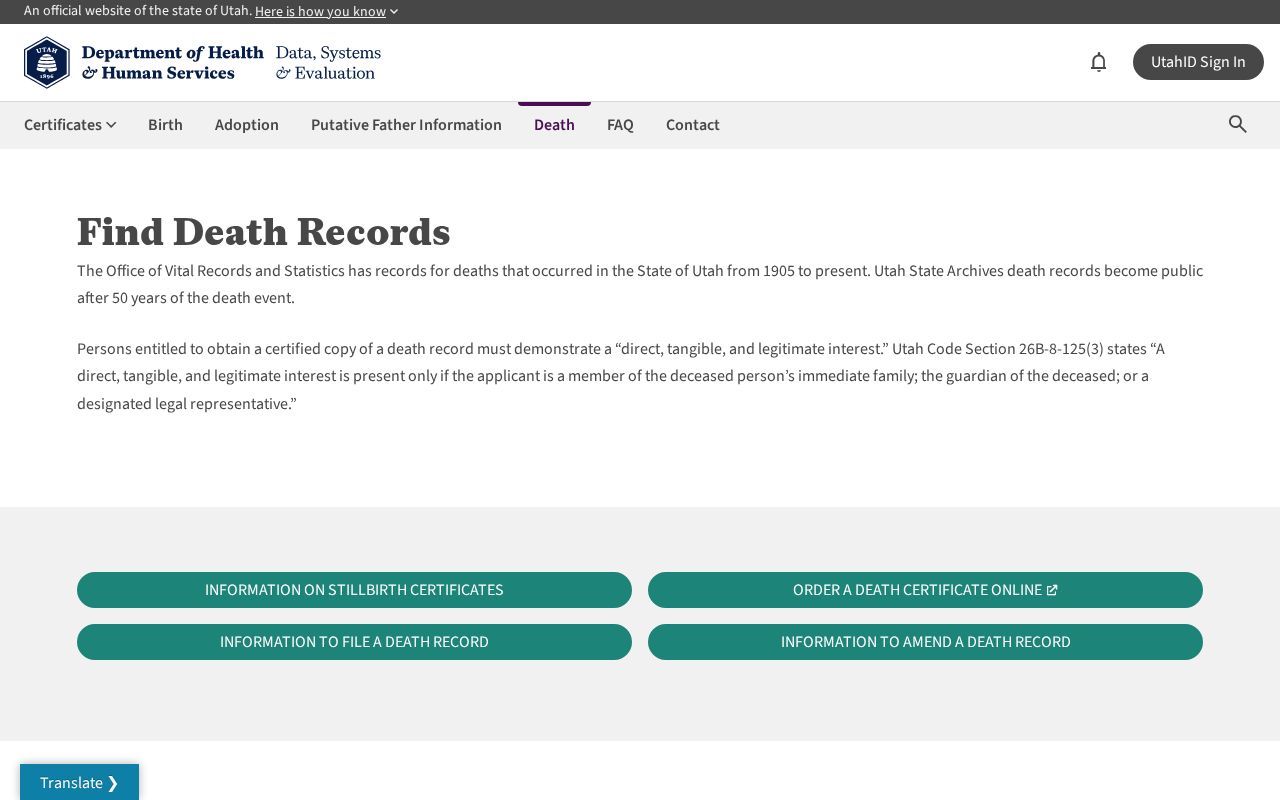
This death-record access image belongs with the eligibility step. Confirm the current fee schedule and relationship rule before sending an application.
Work Around Lehi Resident Name Traps
Test surname-first and given-name forms, initials, business suffixes, alternate spellings, and a known county or court. Compare a parcel serial, address, relative, birth date where lawfully visible, date, or profession. Do not merge two records simply because names match. A court address, voter address, property mailing address, business principal, and actual residence are different fields.
A no-result can mean a protected voter, an expunged case, a vital record inside its confidentiality period, an old justice file not converted, a spelling variation, a transfer, or a retention limit. Write the reason as uncertainty instead of filling it with a guess. The strongest resident lookup usually has two independent records and a source date.
Check Lehi Resident License Links
Utah DOPL’s license verification has a Name Search route and a license-number route. The core number can return several licenses, while a four-digit suffix narrows a specific license. Results can show Licensee Name, City, Profession, License Number, Status, and an expiration date in detail. DOPL guidance says the lookup updates daily at 9 p.m.; inspect active, expired, superseded, or null-and-void entries before deciding what a result means.
Utah Commerce provides Business Entity Search by name or entity number, Registered Principal Search, business-list routes, UCC or CFS searches, and certificate requests. These are current business connections, not a full occupation list or residence proof. Lehi’s Information Center handles city business-license questions at 131 N 100 E, 385-201-1000, and directs entity questions to the state division.
Utah DOPL verification is the source for this license-search image.
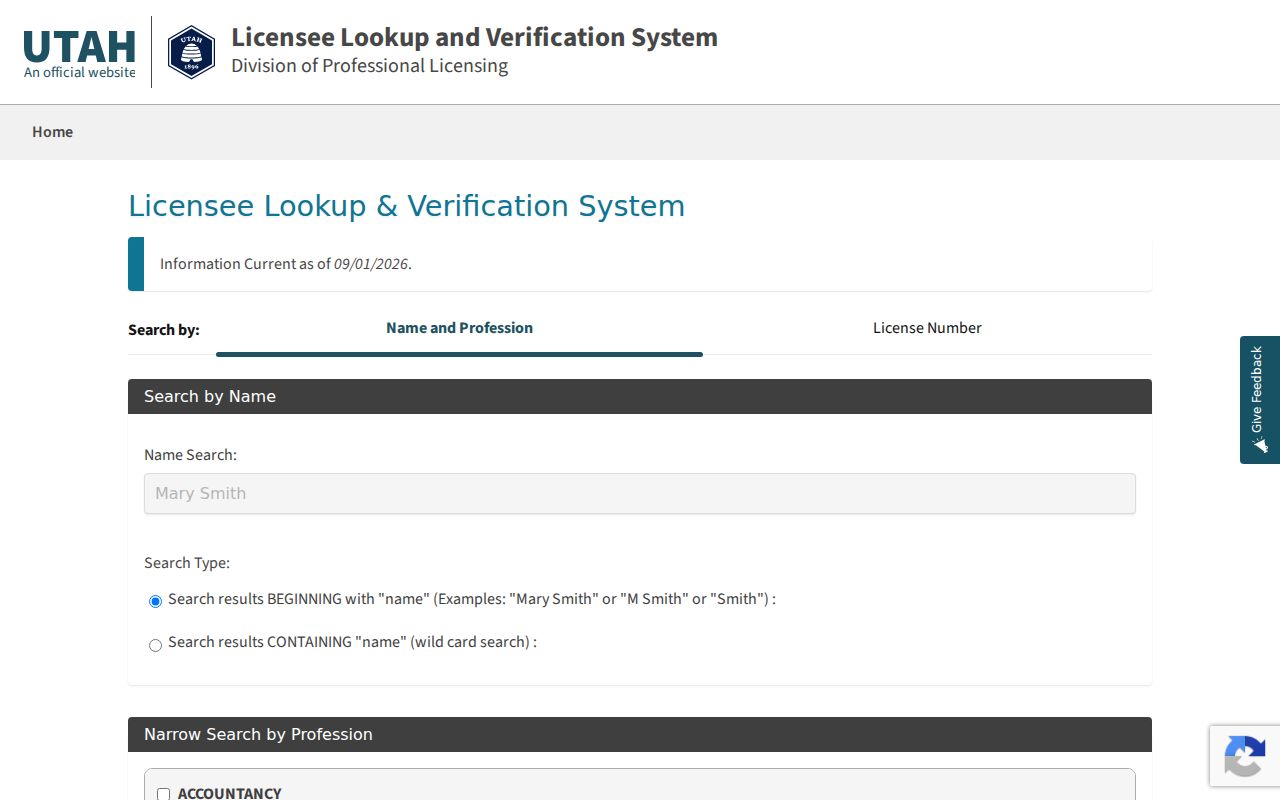
The DOPL image shows the result fields to copy into a source log, including status and license number.
Find a Historic Lehi Person
For a family or heir question, start with a directory, newspaper, cemetery map, Archives index, FamilySearch collection, or Historical Society catalog. FamilySearch’s Lehi Ward Record of Members covers 1856–1903. The Society’s resources include digitized newspapers, yearbooks, Sanborn maps, family histories, and the Wayne E. Clark pioneer collection. Access may require an account, staff help, or permission.
Move to a vital certificate only when the relationship rule allows it. A newspaper obituary can suggest a relationship or date, while a deed can place a person in a property chain. Keep names, dates, address wording, record number, image or page, and uncertainty. Historical identity is not automatic proof of a current Lehi resident.
Understand Protected Missing Addresses
Utah Safe at Home serves victims of domestic violence, stalking, human trafficking, and sexual assault, along with described abuse circumstances. The program can provide a substitute legal address and mail forwarding at no cost. The actual address, county or precinct, and phone are confidential, and actual-address release is limited to specified criminal-justice requests. Enrollment lasts four years and is renewable.
Voter privacy rules also shield Social Security numbers, driver-license or state-ID numbers, email, full birth date, phone, and signature. At-risk or protected voters can be anonymized or omitted. If a record is wrong, contact the government custodian for correction. If a private data broker has copied a source, its opt-out route cannot erase the underlying county or state record.
Custody searches are narrow too. The Utah County jail roster covers the last two years, can lag up to 24 hours after booking, keeps booking photos for 30 days, and booking information for one year. Utah DOC’s search covers current incarcerated, probation, and parole records, not county pretrial cases. The federal locator covers federal custody records from 1982 to the present. A missing roster result is not proof that a person has never had a case.
Registry information carries its own safety limits. The Utah County Sheriff’s registry page routes to Utah and national resources, while UDC VINE provides name or offender-number search and notification options. Utah law prohibits using registry information to harass or threaten. A resident lookup should describe the official status shown and avoid turning a narrow record into a broad statement about a person.
For every result, preserve the source URL, search date, spelling, record number, county or court, and the field that made the match plausible. Two independent records are better than a long list of weak matches. If the question changes from one person to the surrounding street, use the by-street route; if it changes to a past household, use the city directory collections.